
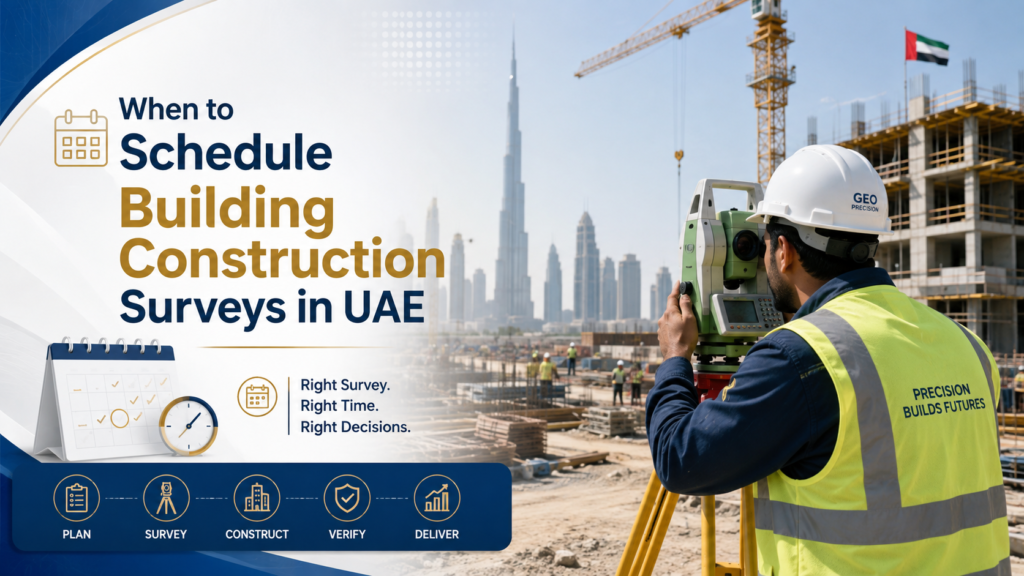
Most rework on a construction site doesn’t come from bad survey work. It comes from a survey booked too late — or skipped at the one stage that actually needed it. To schedule building construction surveys on a UAE project correctly, contractors need to know not just what each survey covers, but when each one happens relative to the pour, the frame, or the cladding front.
Here’s how a building construction survey scope maps onto a typical UAE build, stage by stage — so it sits on the programme as a milestone, not an afterthought.
Before Excavation: Confirm the Reference Points First
Every survey on site depends on the control points established before work starts. If these are wrong, or if they shift during early earthworks, every setting-out call that follows inherits the same error. Book this check before excavation begins, not once foundation work is already underway. A day spent verifying reference points here saves weeks of correction later.
At Foundation Stage: Setting Out Before Every Pour
Gridlines, column positions, footings, and level benchmarks need transferring from the drawings before concrete goes in — not after. Schedule setting-out surveys as a fixed checkpoint ahead of each pour, tied directly to the concrete programme rather than run “whenever the surveyor is free.” Foundation errors are the most expensive to fix once cured, so this is the stage where the survey deserves the tightest slot on the programme.
During Superstructure: One Check Per Floor Cycle, Not Per Milestone
This is where schedules go wrong most often. Teams sometimes plan verticality checks at project milestones — 20th floor, 40th floor — rather than every floor. But drift compounds. A small deviation at floor 12 that goes unmeasured until floor 25 has already multiplied across thirteen levels of construction.
Build the survey into the floor cycle itself:
- One plumbness and axis check per floor, before the next level’s formwork goes up
- A lateral movement reading logged against the previous floor’s baseline
- A short deviation report the site team can act on immediately, not weeks later
Tying this to the floor cycle rather than a milestone date is what keeps a 60-story build on its intended axis.
Ahead of Cladding Installation: Alignment Before the Fronts Move
Façade and cladding contractors work in installation fronts, moving section by section across the building face. Alignment surveys need to run ahead of each front, not behind it — if the cladding crew arrives before reference lines are marked, they either wait or install off a guess. Coordinate this survey stage directly against the cladding subcontractor’s own programme, not the main contractor’s general schedule, since the two rarely move at the same pace.
At Handover: As-Built Verification, Not a Formality
The final survey stage confirms what was actually built matches what was designed — column positions, floor levels, façade panels, all checked against the approved drawings. Treat this as a scheduled deliverable with its own lead time, not something squeezed in during snagging week. Consultants and municipalities expect this documentation before sign-off, and a rushed as-built survey is where late-stage disputes usually start.
Building Survey Milestones Into the Programme
A simple way to avoid last-minute survey requests: list every survey checkpoint alongside the concrete, steel, and cladding milestones on the master programme, not on a separate quality-control sheet. When the survey team sees the same programme the site team works from, mobilisation stops being reactive.
Frequently Asked Questions
How far in advance should we book a survey crew for a new stage? For routine setting-out and floor-cycle checks, a few days’ notice is usually enough on an established contract. For handover as-built surveys, build in at least one to two weeks, since documentation and consultant review take longer than the fieldwork itself.
What happens if a floor’s verticality check gets skipped? The deviation carries forward uncorrected into the next floor’s setting out. It’s usually still fixable if caught within a floor or two, but the correction gets more disruptive — and expensive — the longer it goes unmeasured.
Can setting out and verticality monitoring run on the same site visit? Sometimes, on smaller structures. On high-rise builds they’re usually separate visits, since setting out happens once per stage while verticality monitoring is a recurring, floor-by-floor check.
Does the survey schedule change for a fast-tracked project? The checkpoints stay the same — what changes is the notice period. Fast-tracked programmes need the survey team embedded on-site rather than booked visit by visit, which is where a dedicated crew works better than an on-call arrangement.
Where This Fits
Arabian SE builds its building construction survey scope around the project programme, not a fixed calendar — setting out before every pour, verticality checks on every floor cycle, and alignment surveys ahead of each cladding front. If you’re putting together a construction programme and need the survey milestones mapped against it, get in touch and we’ll scope it against your actual schedule.